

What “reconstructed vs disclosed prompts” means
When people ask about reconstructed vs disclosed prompts, they are comparing two very different sources of information. A disclosed prompt is text the video creator has deliberately published, usually in the YouTube description, a pinned comment, a caption, or a linked post. It is evidence from the creator, although it may still be incomplete or edited for readability.
A reconstructed prompt is an informed description generated after examining the video itself. A vision model can identify visible subjects, composition, movement, lighting, camera behavior, and broad style. It then turns those observations into prompt-like language. That result can be useful for creating a similar video, but it is a best-effort interpretation, not a recovered copy of the original instructions.
This distinction matters because the final pixels do not contain a readable record of every setting or phrase used to make them. Different prompts, models, seeds, edits, and workflows can produce similar footage. A responsible tool therefore labels whether its result was disclosed by the creator or reconstructed from visual evidence instead of implying that every answer is an exact extraction.
How a disclosed prompt is identified
A tool looking for a disclosed prompt first checks the text surrounding the video rather than guessing from frames. On YouTube, that can include the description and comments. A creator might write something as direct as “Prompt: a slow tracking shot through a neon-lit market at night,” or may provide a longer prompt alongside model and parameter details.
Not every nearby sentence qualifies as a prompt. A title such as “AI cyberpunk city” is a topic, not necessarily the generation instruction. Likewise, a comment saying “I used an AI video tool” confirms a workflow but does not disclose the wording. Good results should preserve this difference and identify the source as creator-provided when the text is actually available.
Disclosed text can also be partial. The creator may share a shortened prompt while leaving out negative prompts, reference images, motion settings, interpolation, upscaling, or post-production. It is reasonable to treat the text as the strongest available evidence, but not as proof that it contains every input used to produce the published video.
What reconstruction can and cannot tell you
Reconstruction works backward from observable results. For example, a clip may show a red fox walking through snow in a wide, cinematic shot, with shallow depth of field, drifting flakes, and a slow camera push-in. A model can describe those features and produce a practical starting prompt such as “cinematic wildlife shot of a red fox crossing a snowy forest, gentle forward camera movement, soft winter light.”
It cannot reliably know whether the creator wrote “red fox” or “arctic fox,” whether the scene began as an image-to-video animation, or which model produced it. It may also miss hidden instructions controlling duration, frame rate, motion strength, seed behavior, guidance, aspect ratio, or consistency. Those details are not visually recoverable with certainty from the finished file.
For that reason, reconstructed output should be judged by usefulness rather than exact wording. The best reconstruction captures the visible concept and production characteristics closely enough to help you experiment. It should not be presented as the original prompt, and a tool should say so clearly whenever no creator-disclosed text was found.
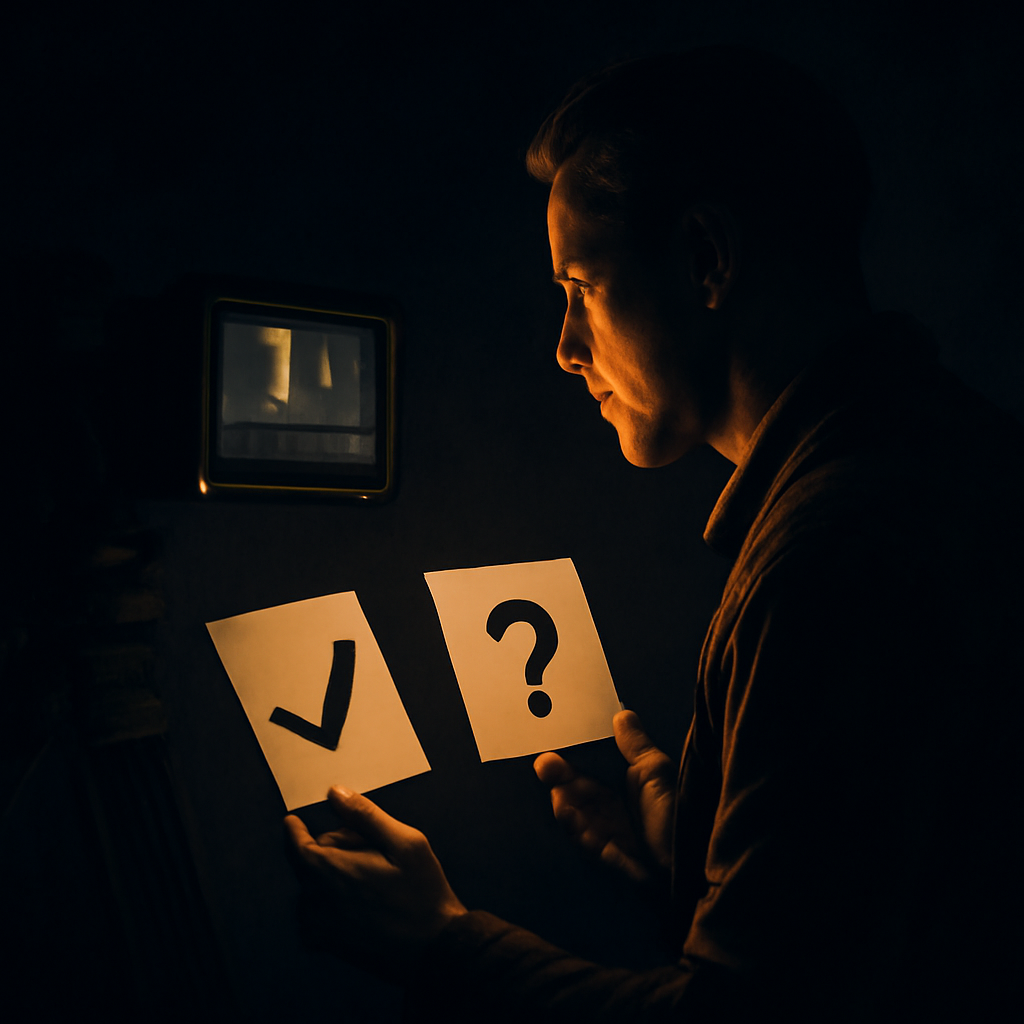
A practical way to tell the difference
Start by checking the result label and its source. Terms such as “creator-disclosed,” “found in description,” or “from a pinned comment” indicate that the wording came from published text. Terms such as “reconstructed,” “estimated,” or “AI-generated interpretation” indicate that the system analyzed the video and composed a new description.
Next, inspect whether the answer contains observations or unverifiable specifics. “Close-up of a woman turning toward the camera in warm sunset light” is a visual observation. A claim that the creator used a particular model, seed, sampler, or exact camera parameter requires separate evidence. If those details are included in a reconstruction, they should be framed as possibilities, not facts.
You can also compare the answer with the video’s description and comments yourself. A disclosed prompt should be traceable to an identifiable creator-written passage, while a reconstruction may use different wording even when it describes the same scene. For a deeper overview of the distinction, see prompt reconstruction vs extraction.
Realistic expectations from video-to-prompt tools
These tools are most helpful when you need a starting point, not forensic proof. Suppose you find a short video of a miniature train moving through a mossy forest. A reconstruction can identify the subject, scale, environment, camera angle, color palette, and apparent motion, giving you a prompt to adapt in your preferred generator.
Results can be less reliable when the video contains rapid cuts, heavy effects, text overlays, unusual anatomy, compression artifacts, or several distinct scenes. A single summary may blend details from different shots. Uploading a clear source file or using a stable video link can help the analysis, but it cannot reveal information that was never visible in the final footage.
It is also worth separating prompt analysis from video replication. A reconstructed prompt may recreate the mood without reproducing exact character identity, timing, physics, or editing. Treat the output as a creative approximation, then refine it with your own tests. In a useful workflow, the tool reduces the blank-page problem while you remain responsible for validation and iteration.
How to use both sources responsibly
If a creator-disclosed prompt exists, begin with that text and keep its provenance clear. Use the reconstruction as a supplement to identify visible details the creator did not mention, such as a slow lateral pan, rim lighting, or a shallow focus transition. This combination is often more useful than either source alone, especially when the published prompt is brief.
If no disclosed prompt is available, save the result as a hypothesis. Compare each major phrase with the footage: is the shot actually handheld, or does it only feel energetic because of editing? Is the light blue and moonlit, or simply low exposure? Removing details that are not supported can make the prompt more portable and more honest.
That approach gives you a clear answer to the central question: disclosed means creator-supplied evidence, while reconstructed means model-generated interpretation. When you are ready to analyze a video, try the video prompt tool. It can check for a disclosed prompt first and provide a clearly labeled reconstruction when no creator-provided wording is available.




Leave a Reply